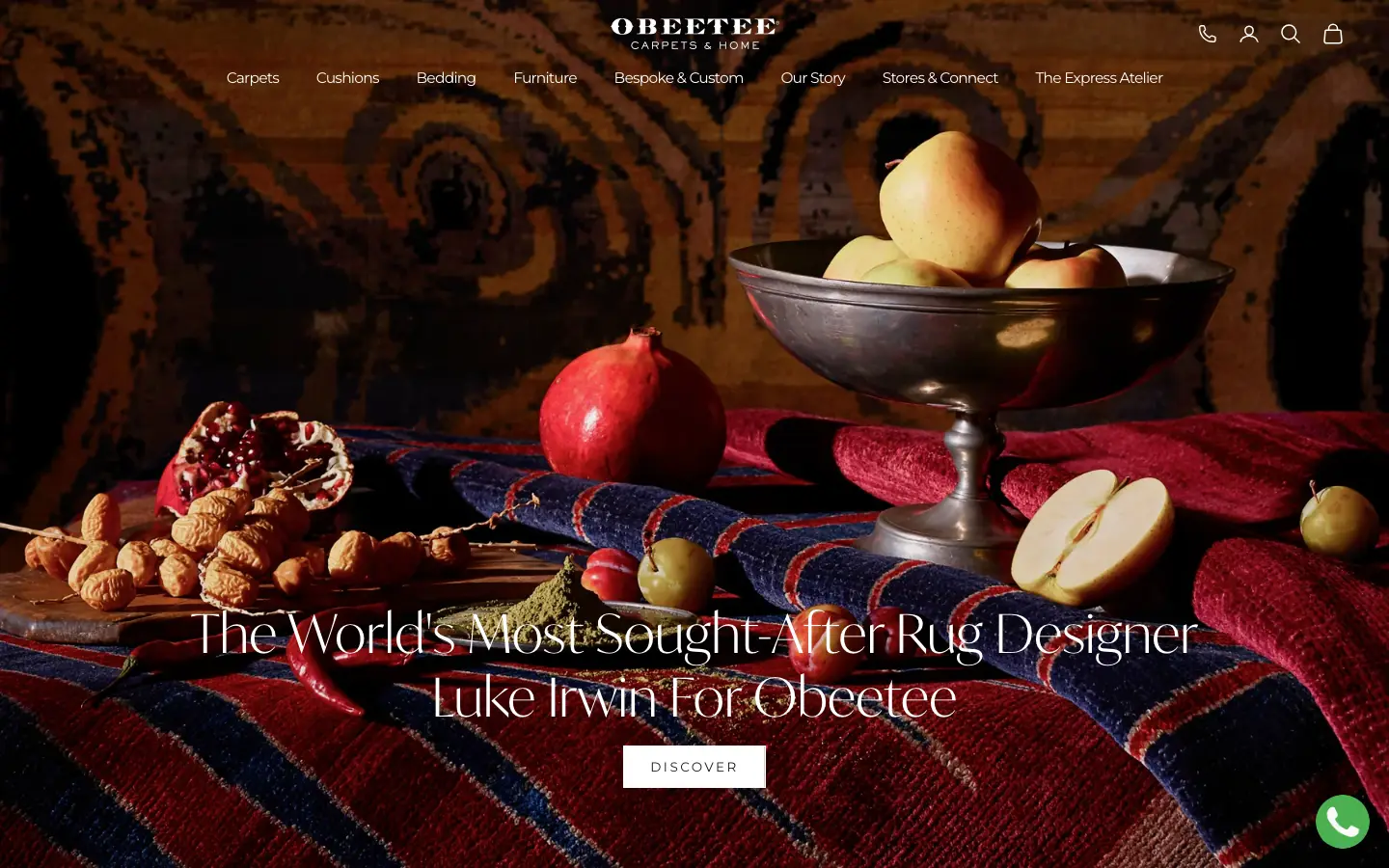
Rug and home-textile brands with craft heritage face a specific tension Shopify has to resolve: the story of how something is made is genuinely part of why a customer pays a premium for it, but that story can't come at the expense of a fast, clear path to purchase — especially for an international buyer comparing your store against global competitors with slicker checkout. The platform's job is to carry the craftsmanship narrative without letting it slow the page down or bury the add-to-cart button.
Because these brands typically sell across borders, the operational bar is also different from a domestic-only store: currency and duty clarity at checkout, image performance on slower or international connections, and localisation that goes beyond translation. A store that works well for a single domestic market often breaks in ways that aren't obvious until an international buyer hits an unexpected duty charge at checkout or a slow-loading, texture-heavy product page on a weaker connection.
Beyond Shopify Markets: the app layer for a global textile catalogue
Shopify Markets solves the core multi-currency and duty problem, but a few other tools matter once that foundation is in place. Wholesale or B2B-specific apps are worth serious consideration for heritage textile brands, since many operate a hybrid model selling both direct-to-consumer and to boutiques or interior designers — a proper B2B storefront with tiered pricing keeps that channel from being bolted awkwardly onto the consumer catalogue. Image CDN and lazy-load apps matter more here than almost any other category, because the texture and weave detail that actually sells a handmade rug requires genuinely high-resolution photography, and that photography is exactly what tanks load time on the international, sometimes slower connections these stores depend on. Care-instruction and product-education apps or metafield-driven content blocks help too, since natural fibre and handmade textiles carry real care requirements a customer needs to understand before buying, not after a maintenance mistake damages an expensive piece. Localisation apps that go beyond word-for-word translation — adapting sizing units and cultural framing per market — round out the stack.
International SEO for a heritage brand means more than translating pages
Multi-market SEO for a global textile brand has to solve two problems a domestic store doesn't face: duplicate-content risk across localised pages, and search behaviour that genuinely differs by market — a US buyer searching "handwoven area rug" and an Indian buyer searching "silk carpet" may be looking at comparable products with completely different vocabulary. Proper hreflang implementation and market-specific URL structure (via Shopify Markets) prevent Google from treating near-identical regional pages as duplicate content, which otherwise dilutes ranking across all of them. Keyword strategy needs to be genuinely researched per market rather than assumed from the home market's vocabulary — craft and material terms in particular vary widely in how international buyers actually search. Content that documents provenance and craft process in real depth also tends to rank well and build backlinks organically, since heritage and craftsmanship stories are the kind of content other sites want to reference and link to, which is a structural SEO advantage domestic mass-market competitors don't have.
Merchandising material, weave, and size complexity without losing the craft story
Rugs and textiles carry a genuinely complex set of buying variables — material (wool, silk, cotton blends), weave technique, size, and often colourway — and the merchandising challenge is presenting that complexity as useful filtering rather than an overwhelming spec list. Structuring material and weave as proper filterable metafields, not just descriptive paragraph text, lets a buyer narrow a large catalogue to what actually matters to them, which matters more in this category than most because material genuinely changes price, care requirements, and durability in ways the buyer needs to understand before committing. Size is a particular friction point for rugs specifically — a buyer needs to relate a listed dimension to their actual room, which argues for room-context photography and, where feasible, a simple visualisation tool rather than a numbers-only size chart. The craft story belongs earlier in the journey — on collection and content pages — while the PDP itself should stay focused on the specific decision: this material, this size, this price, with the story present but not obstructing.
Cross-border shipping and returns for bulky, high-value textile goods
Rugs and large textile pieces sit in an awkward logistics category — too bulky and heavy for standard parcel rates, but not always justifying full freight infrastructure, especially for a mid-sized heritage brand shipping internationally. Duty and import tax clarity at checkout is the single highest-leverage fix available: a buyer who reaches checkout only to discover an unexpected customs charge on an already-expensive rug abandons at exactly the point they were ready to buy, and Shopify Markets' duty-inclusive pricing directly solves this rather than leaving it as a post-purchase surprise. International returns are genuinely expensive for bulky goods — return freight on a large rug can approach the product's own shipping cost — which makes accurate expectation-setting (true-to-life colour photography, precise dimensions, weave close-ups) more valuable as return prevention than as a policy to fall back on afterward. Where a return is unavoidable, offering a partial refund or store credit in lieu of full reverse freight is often the more economical resolution for both sides than shipping the item back internationally.
Why story-led content and press outperform paid acquisition for craft-led textile brands
Heritage and craft-led brands have a genuine advantage that pure D2C fashion or beauty brands don't: a story worth telling, which makes editorial press, design-publication features, and long-form content disproportionately effective compared to paid social acquisition. A feature in an interior-design publication or a well-placed piece about the weaving tradition behind a collection does real trust-building and SEO work simultaneously, in a way a paid ad simply can't replicate for this audience. Instagram and Pinterest still matter, but the content that performs is process and provenance content — the loom, the artisans, the making — rather than pure product shots, because that's precisely what differentiates a craft brand from a mass-market alternative at a similar price point. Interior designers and stylists are also a worthwhile channel to court directly, since a single respected designer citing or using a piece carries outsized credibility with exactly the higher-spending audience this category depends on.
Justifying premium pricing against mass-market alternatives
A handloom or heritage textile piece is almost always priced well above a machine-made equivalent, and the PDP has to actively make the case for that gap rather than assume the craft story alone will justify it. Specificity does the real work: naming the actual technique, the region, the time a piece takes to make, and the number of hands involved gives a buyer a concrete reason for the price difference, where vague heritage language doesn't. Genuine provenance documentation — where and by whom a piece was made — functions as both an ethical and a trust signal for buyers increasingly conscious of sourcing. Because these are often one-of-a-kind or limited-run pieces, honest scarcity messaging works well and doesn't need to be manufactured the way it sometimes does in mass-market fashion — if a piece really is limited, saying so plainly is both accurate and persuasive.
The most common technical mistake global textile stores make on Shopify
The most common failure is running international sales through a single-currency, single-language store bolted onto with a currency-converter widget rather than a proper Shopify Markets setup — the difference shows up as cart abandonment when a buyer sees a price in an unfamiliar currency with duties added only at the final checkout step. A second common mistake is serving full-resolution, unoptimised photography to every visitor regardless of device or connection, which disproportionately hurts exactly the international traffic these brands depend on and directly damages Core Web Vitals and search ranking. A third mistake is running separate stores per country instead of one unified Markets instance — this multiplies operational work for every price change or new collection and fragments customer data so that behaviour in one market becomes invisible to decisions made about another, undermining the whole point of expanding internationally in the first place.
What a heritage textile or rug brand typically spends on Shopify and international growth
Cost in this category is driven by one thing most domestic-only D2C brands never budget for: genuine multi-market infrastructure. An early-stage textile brand selling primarily to one country can launch for $4,000–$10,000 upfront (Shopify Markets setup, an image-optimisation pipeline for craft-detail photography, basic localisation) plus $2,000–$5,000 a month for content and CRO. A brand actually competing internationally — duty-inclusive pricing across several markets, hreflang-correct localised content, wholesale/B2B alongside DTC — typically needs $15,000–$40,000+ for the build and $10,000–$25,000+ a month in growth spend, with a meaningfully larger share than most categories going to image-pipeline and localisation work rather than paid acquisition, since unoptimised high-resolution photography is what most often tanks Core Web Vitals for this vertical. The biggest swing factor is market count: a brand serving two markets needs modest incremental spend over a single-market store, but a brand genuinely serving five or six needs proportionally more investment in market-specific keyword research, localisation beyond translation, and freight/duty logic, since each new market adds real operational surface area, not just a currency toggle.
Why international textile brands see a slower but more durable ROI curve
Payback in this category runs slower than a single-market D2C store because the fixes address structural friction — duty confusion, slow image load on international connections, fragmented multi-store operations — that takes a full market-by-market rollout to resolve, typically showing measurable cart-abandonment improvement within 90–120 days of a proper Shopify Markets migration rather than immediately. But the ROI, once it lands, tends to be more durable than a purely domestic brand's, because craft-heritage content and editorial press generate ongoing organic traffic and backlinks that don't decay the way paid campaigns do, and a unified Markets instance means every subsequent price change or new collection is deployed once rather than once per country, compounding the return on the original engineering investment. What's genuinely different about this vertical's growth economics is that premium pricing has to be actively justified against mass-market alternatives, so a meaningful share of ROI comes from content and provenance storytelling rather than conversion-rate optimisation alone — which argues for a team, in-house or agency, that can do real editorial and press work, not just funnel testing.